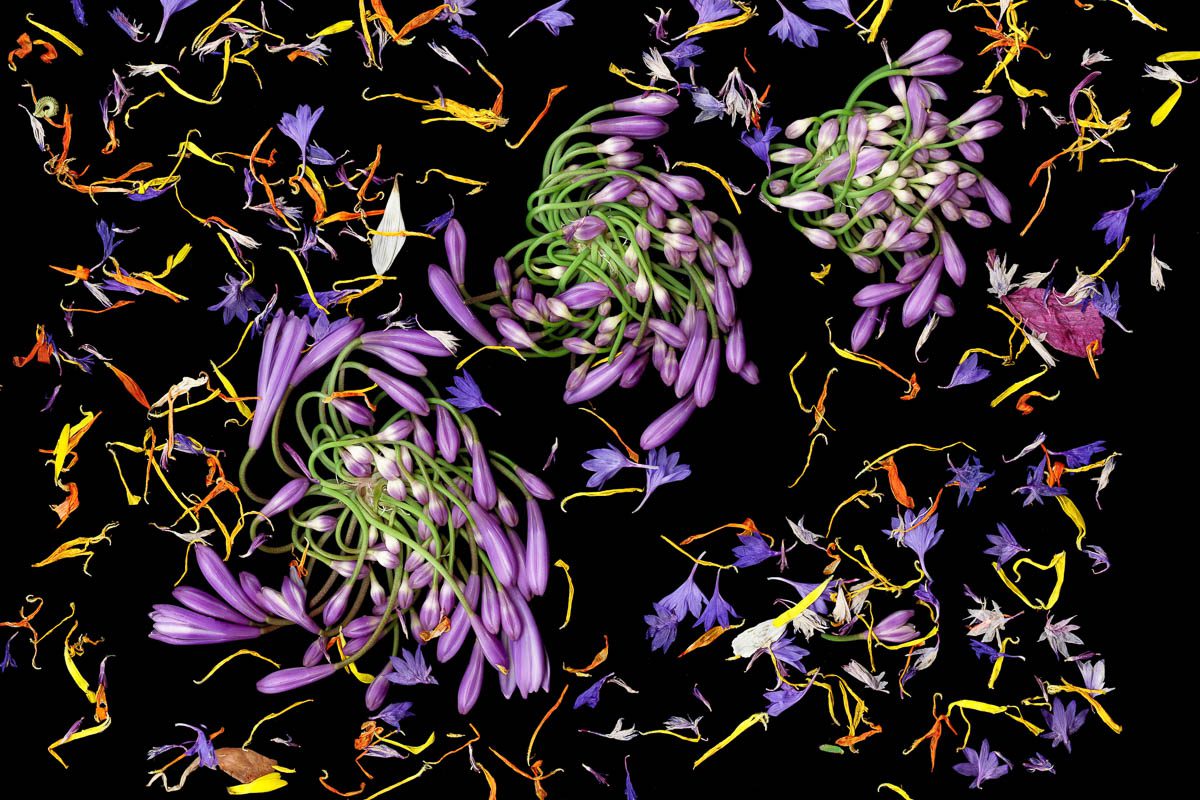
What is Scanner Art?
Scanner Art, sometimes called scanography, is a form of photography created without a traditional camera. Objects are arranged directly on the glass of a flatbed scanner, where a moving light source reveals extraordinary detail, color, and texture.
My interest in Scanner Art grew from a long-standing fascination with the beauty of decay, as exemplified by Wabi-sabi, the traditional Japanese aesthetic and worldview centered on the acceptance of transience, imperfection, and simplicity. It finds quiet beauty in things that are flawed, weathered, incomplete, or marked by the passage of time.
In 2005, I began a project to photograph faded rose petals. I initially planned to use my 4×5 view camera, but the setup proved more complex than I expected. Instead, I placed a dried rose directly on the scanner glass and made my first scan. The result was startling. The rose seemed to glow against the black background, revealing textures and colors I hadn’t anticipated. That discovery opened an entirely new direction for my photography.
Over time, my process evolved to include carefully dried flowers, leaves, seeds, shells, rust, and other found objects. Each composition begins by arranging the objects directly on the scanner glass, experimenting with their placement, relationships, and how the scanner’s light reveals their textures and colors.
Although the scanner captures the initial image, the finished artwork requires many hours of careful adjustments to color, contrast, and detail, along with test prints. Some pieces require up to 20 hours of exploration, experimentation, and refinement.